


How Warfare Changed Daily Life in the Middle Ages
Posted by The Museum Replicas Team on Jul 11th 2026
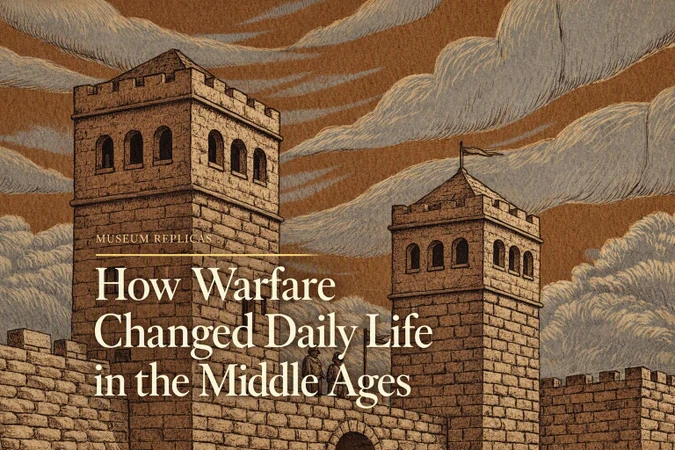
The bell at Saint Wulfram's did not ring for Mass that morning. It rang three quick strokes, paused, and rang three more, the old signal that meant riders had been seen on the ridge road. Within minutes the miller's boy was driving the cattle inside the palisade, the smith had set down his hammer to string his bow, and a woman who had been kneading bread an hour before was now handing bundles of arrows up to her husband on the wall. By the time the riders proved to be nothing more than a merchant's guard running late, half the village had already rehearsed, for perhaps the hundredth time that year, what it meant to live somewhere that war could arrive before noon.
This was the ordinary texture of life across much of medieval Europe, and it is easy to lose sight of it. We tend to picture the era through its grand set pieces, the pitched battle, the siege, the knight in gleaming plate. What gets left out is how thoroughly the possibility of violence reshaped everything that happened in the quiet months between one campaign and the next. Warfare in the medieval era was not a separate category of life, sealed off from farming and faith and family. It was woven through all three.
Villages Built for Watching
Long before castles rose in stone, communities were already organizing themselves around the threat of raid and invasion. A village near a contested border looked different from one tucked safely inland, and not by accident. Houses clustered tighter. Livestock pens sat closer to the center. Someone, usually the oldest boy not yet fit for the fields, was given the job of watching the road, and every child learned early which bell pattern meant trouble and which meant nothing at all.
Knights in medieval Europe were not simply warriors who happened to live nearby. They were the reason a village could afford to plant crops in an exposed valley instead of retreating to higher, poorer ground. In exchange for that protection, the peasantry owed labor, grain, and eventually their own sons when the muster came. It was a bargain struck in blood and bread, and everyone involved understood the terms even if no one wrote them down.
The Rhythm of a Warring Season
War in this period had a calendar. Campaigns began after the spring planting was done and the roads had dried enough to move an army, and they ended, ideally, before the harvest needed every hand back in the fields. A lord who called his levy too early risked starving his own lands the following winter. This seasonal rhythm meant that for a farmer, the line between soldier and civilian was not a fixed identity but a role that shifted with the sun.
Weapons in medieval times reflected this reality as much as any tactical doctrine. A billhook or a modified farm scythe could be pressed into service by a man who had never held a proper sword, and the difference between a peasant levy and a professional retinue often came down to exactly this: who owned purpose built arms and who was making do. The blacksmiths who spent the winter repairing plowshares spent late summer repairing spearheads, sometimes for the very men who would carry them.
Trade, Craft, and the Business of War
Armor and weaponry were expensive, and that expense rippled outward into every corner of the economy. A single suit of mail could represent months of a smith's labor, and a lord equipping even a modest retinue was making one of the largest financial commitments of his year. This created entire industries built around supply, from the mines that fed the forges to the merchants who moved finished blades along trade routes that were themselves often protected, ironically, by the very swords they carried.
Towns that specialized in arms production, places whose names still carry that reputation centuries later, grew wealthy precisely because war was a recurring, predictable demand rather than an occasional emergency. Craftsmen passed techniques down through families, guilds formed to protect trade secrets, and a kind of arms race in miniature played out in workshops long before it ever reached a battlefield.
Faith, Fear, and the Space Between
The Church did not stand apart from this world, it was deeply entangled in it. Priests blessed weapons before campaigns and prayed over the dead after them. Relics were carried into battle as talismans, and victories were as often credited to a saint's intervention as to any tactical decision. For the ordinary person, faith offered one of the few frameworks for making sense of a violence that could, without warning, upend an entire community's fortunes.
This is also where some of the era's most enduring myths take root. Popular imagination tends to flatten medieval combat into a single image, armored men colliding in open fields, when the reality included ambushes, sieges that dragged on for months, and long stretches where the greatest danger was disease moving through a camp rather than an enemy blade. The daily experience of war, for most people, was less about the moment of battle and more about the waiting, the provisioning, and the aftermath.
What the Era Left Behind
Look closely at the objects that survive from this period, a helm, a sword, a length of mail, and you are looking at more than martial hardware. Each piece carries the imprint of an economy built around necessity, a craftsmanship refined by constant demand, and a society that never quite got to set war aside long enough to forget what it cost.
Our own team has learned this the same way, less from books than from talking with historians and with the people who put this gear on today, the reenactors and HEMA fighters who can tell you within a minute whether a sword balances the way one should. Reproducing a medieval blade or mail shirt is never just a matter of matching dimensions off a museum original. Weight, balance, and proportion have to work for the hand actually swinging it, a hand that on average belongs to someone larger than the person the original was forged for eight hundred years ago. Getting that right is the difference between a wall piece and something that moves the way its ancestor did.
That is part of what makes handling an honest replica of the period so different from simply reading about it. The weight in your hand is the same weight a smith spent a season earning his keep by producing, for a customer who very likely needed it to survive the season after.
Understanding how deeply warfare shaped daily life does not require imagining constant battle. It requires imagining a world where the possibility of it was always present, quietly organizing villages, economies, and even the rhythm of the farming year around a threat that might, on any given morning, prove to be nothing more than a merchant running late.
Last updated September 2026.