


The Legend of Excalibur: History Behind the Sword in the Stone
Posted by The Museum Replicas Team on Aug 12th 2026
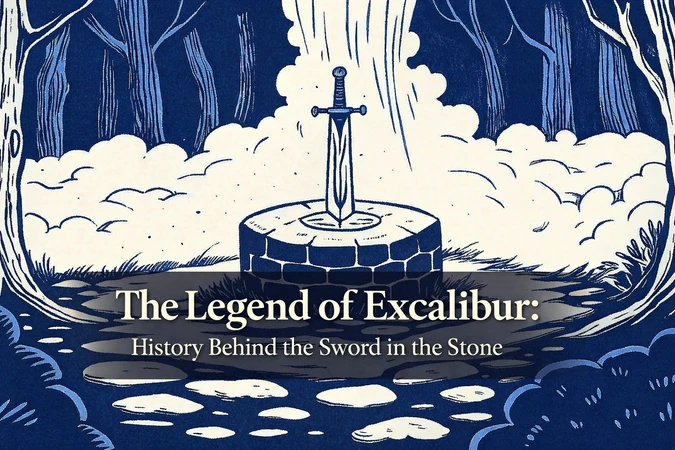
A blade pulled from stone, and from something older still
A boy kneels before an anvil driven through a slab of rock, closes both hands around a hilt no man of rank could budge, and rises a king. It is one of the most durable images in Western storytelling, and it has almost nothing to do with the sword that actually made Arthur famous. The sword in the stone and Excalibur are not, in the earliest tellings, the same weapon at all. That confusion says something worth pausing on before we go further.
Where the legend actually comes from
Arthur first appears with a sword called Caledfwlch in Welsh tradition, most memorably in the prose tale Culhwch and Olwen. Geoffrey of Monmouth, writing his Historia Regum Britanniae around 1136, Latinized the name as Caliburnus. Geoffrey gives us the name but not the stone. That detail arrives around 1200, through the French poet Robert de Boron, who introduced the trial of the sword in the stone as proof of Arthur's bloodline. In de Boron's version, this stone sword and Excalibur are two separate weapons. It's Thomas Malory, completing Le Morte d'Arthur around 1470 (William Caxton printed it in 1485), who folds them into one blade and gives us the version most people carry around in their heads today, the sword drawn from stone in Arthur's youth and, in Malory's telling, later shattered and replaced by a second Excalibur granted by the Lady of the Lake.
So the legend was never one clean story. It was centuries of storytellers reworking, borrowing, and improving on what came before, which is exactly how legends survive long enough to become legends.
What kind of sword was Arthur supposed to be carrying
Malory was writing in the 1400s about events he set in the fifth or sixth century, and he dressed his Arthurian world in the armor and arms of his own era rather than the one he was describing. That gap between story and setting has followed nearly every retelling since. Illustrations, films, and replicas tend to show a sword straight out of the high medieval knightly form, a straight double edged blade, a cruciform hilt, built for a mounted knight rather than a Dark Age warlord. It's historically inaccurate to the fifth century and completely faithful to the legend as it's actually been told for six hundred years. Chasing literal accuracy to a period before the story was even set down would mean abandoning the version of Excalibur that everyone actually recognizes.
Why the legend refuses to die
A sword that grants kingship isn't really a story about a weapon. It's a story about legitimacy, about the idea that true authority is recognized rather than seized, which is precisely why it has stayed useful to storytellers for eight hundred years and counting. Every retelling asks the same underlying question in new clothes: what makes a ruler rightful. Malory's telling served a fifteenth century audience anxious about civil war and legitimate succession. Later versions have found their own reasons to keep asking. The sword changes hands, changes hilts, changes centuries, and the question underneath it never quite goes away.
Holding the legend
There is a particular kind of satisfaction in holding a piece of a story that old, and it is much of the reason Museum Replicas has existed since 1985, when we set out to bring historical and legendary swords within reach of American collectors. A legendary sword poses a harder question than a historical one, because there is no single original to measure against. The honest answer, and the one our research kept returning to, is the form the legend has actually worn for six centuries: the medieval knightly sword of Malory's era.
Our Excalibur is forged by Windlass Steelcrafts, who have been making blades since 1943. It is hand forged from 1080 high carbon steel and factory sharpened. The fittings wear an antique finish, and the two handed grip and wooden scabbard are wrapped in soft blue leather, details meant to suggest a blade that has actually seen a court and a battlefield rather than a display case. You can find the sword itself here.
A story this old was never going to stay only on the page. It was always going to end up back in someone's hands.
Last updated September 2026.