


What Was the Medieval Era? A Guide to Its Dates and Defining Features
Posted by The Museum Replicas Team on Jul 25th 2026
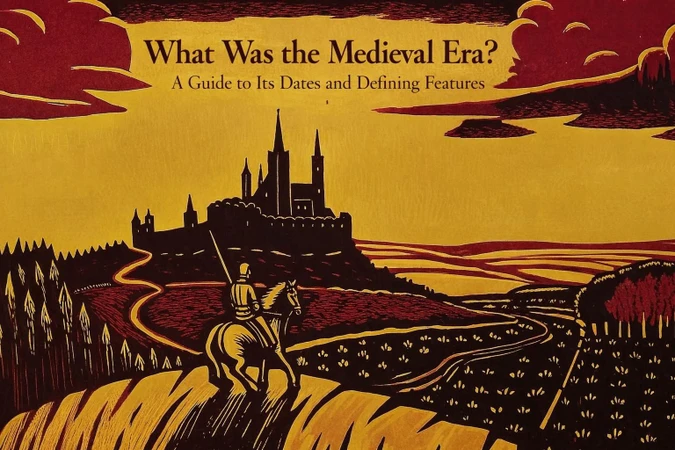
The medieval era ran roughly from 476 AD, the fall of the Western Roman Empire, to 1453 or thereabouts, when Constantinople fell and the printing press was already reshaping how Europe thought. A thousand years is a long time to compress into one label, and the people living through the first century of it would not have recognized much in the last.
When did it actually begin and end
Historians rarely agree on hard edges for an era this long, and for good reason. Rome did not collapse in a single afternoon, it eroded over generations, and the "medieval" label itself was coined centuries later by Renaissance scholars who wanted a tidy name for everything sitting between their own age and the classical one they admired. That's worth remembering. The people of the twelfth century did not think of themselves as living in the middle of anything. The bracket is a modern convenience, useful, but a convenience all the same.
Three ages wearing one name
Scholars generally split the era into three stretches. The Early Medieval period, roughly 476 to 1000, covers the fragmentation after Rome, the rise of the Frankish kingdoms, and the slow spread of feudal structures across a Europe with no strong center left standing. The High Medieval period, 1000 to 1300, is the era most people actually picture, castles, crusades, cathedrals, the height of chivalric culture and knighthood as a defined institution. The Late Medieval period, 1300 to roughly 1500, brought the Black Death, the Hundred Years' War, and the slow cracking of the feudal order that eventually opened onto the Renaissance.
What actually held the era together
Land and loyalty ran everything. A king granted land to lords in exchange for military service, lords granted portions to knights on the same terms, and the whole structure rested on personal obligation rather than centralized bureaucracy. The Church supplied the other half of the frame, the one institution with reach into every kingdom, every court, and most of the era's art, law, and education. Castles rose because a lord needed a defensible seat to hold that land, and towns grew slowly around the trade routes and guild economies that fed everyone above them.
The knight, and the sword that defined him
No figure represents the era more completely than the mounted knight, and no object represents the knight more completely than the sword at his hip. Through most of the High Medieval period that sword was the arming sword, a straight, double edged blade meant to be carried in one hand alongside a shield, light enough to swing from horseback and simple enough to maintain in the field.
As plate armor improved through the Late Medieval period, the sword had to answer it. The longsword, sometimes called a bastard sword for its awkward place between one hand and two, gave a knight the reach and leverage to fight on foot against an armored opponent, gripped with either hand depending on the moment. Push the blade and grip even further and you reach the true greatsword, a two handed weapon built for men who needed to clear space on a crowded battlefield rather than duel one opponent cleanly.
Not every fighting man could afford a knight's blade, and the era's medieval swords and daggers reflect that gap. The falchion, single edged and cheaper to forge than a straight double edged blade, gave common infantry and militia a real cutting weapon without a knight's price tag attached. It's a useful reminder that the medieval battlefield was never just knights. It was mostly everyone else.
Producing these forms today has taught our team something the sources don't always spell out: people were smaller. Years spent talking with historians, and with the reenactors and HEMA practitioners who actually wear armor and handle these swords now, keeps turning up the same gap. A hauberk or an arming sword built for a fifth century Frank or a fifteenth century Burgundian assumes a frame several inches shorter and considerably narrower than most hands reaching for a replica today. Getting the weight and balance right for a modern grip, without losing the geometry that made the original work, is most of the craft in bringing one of these pieces back.
How the era came apart
The Black Death arrived in 1347 and killed something close to a third of Europe within a few years, and a labor shortage that severe broke the feudal arrangement from the bottom up, since peasants who survived suddenly had leverage they'd never held before. The Hundred Years' War dragged English and French claims through more than a century of intermittent fighting, and gunpowder weapons started making plate armor and mounted knights look increasingly like an expensive answer to a question war was no longer asking. By the time Constantinople fell in 1453, the world that had organized itself around land, loyalty, and the mounted knight was already being replaced by one organized around something else entirely.
A thousand years rarely ends cleanly, and this one didn't either. But by 1500, nobody would have mistaken the world for the one Charlemagne had ruled.
Last updated September 2026.